
Written by the GKFTII Academic Content Team, in collaboration with School of Film & Television faculty
Most first-time filmmakers either freeze trying to write something "important" or jump straight to shooting without a plan and end up with footage that doesn't cut together. A good short film making course exists to fix both problems at once — it gives you small, structured exercises before it ever hands you a full project, so your first short film isn't also your first time holding a camera with intent and managing a small cast all at once.
Before tackling a full short film, it helps enormously to practice on something tiny and rule-bound — a continuity exercise built around just ten shots, for example, where the only goal is making each cut feel seamless rather than telling a complete story. That kind of drill teaches shot-to-shot logic without the pressure of a narrative, and it's far easier to fix a continuity mistake on a ten-shot exercise than to discover it three days into shooting a real short, when the location and cast might not even be available to reshoot the fix.
A beginner's biggest planning mistake is writing a script that needs a location, cast, or effect they can't realistically get. A first short film should be written backward from your real constraints: one or two locations you can actually access, a cast of two or three people you can rely on for multiple sessions, and a story that doesn't depend on anything you'd need a permit or a stunt team for. Ambition is good; a script that collapses the moment your one location falls through is not.
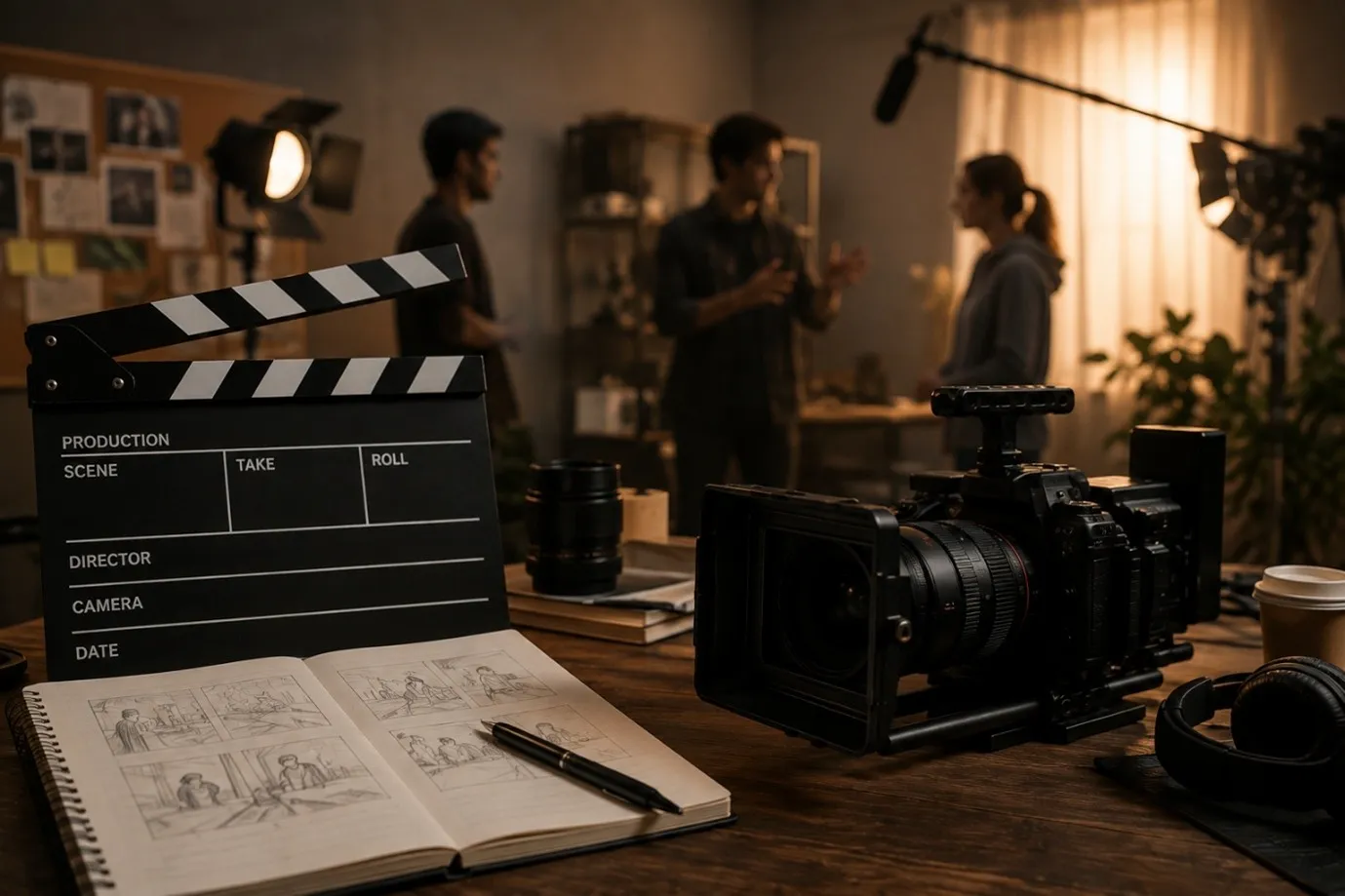
One underrated exercise for beginners is building a short visual story entirely out of still photographs before ever touching motion footage. It forces you to think purely in terms of composition and sequence — what single image starts the story, what image complicates it, what image resolves it — without worrying about performance, motion, or sound at the same time. That sequencing instinct transfers directly once you do pick up a camera for video.
A first-time director almost always under-shoots coverage because they're confident they know exactly what they need. Experienced editors will tell you the opposite is safer: shoot a few extra angles of anything that matters, because you can't fix a missing reaction shot in the edit room no matter how good your software is. Planning your shot list with the edit already in mind — asking "will I actually be able to cut this together" — saves far more time than it costs on set, and it's a habit that separates a finished short film from a folder of footage that never quite becomes one.
The point of a first project isn't to make something festival-ready. It's to survive the full pipeline once — writing, scheduling, shooting across more than one day, and cutting a final version — so the next one is built on real experience instead of guesses. A ten-minute short, finished and structurally sound, teaches more than a feature script that never gets shot, simply because it forces every weak assumption in your planning to surface while the stakes are still low.
Picture two students starting at the same point. One jumps into a fifteen-minute short with five locations and a cast of eight, gets overwhelmed by week three, and never finishes it. The other spends the first few weeks on ten-shot continuity drills and a still-photo story before touching a real script — and walks away with a finished ten-minute short.
Neither student lacked ideas or talent — the difference was sequencing. One tried to learn everything at once under real pressure; the other built up to it in pieces small enough to get right.
That's what a properly structured short film making course really offers — not inspiration, but an order of operations that turns a good idea into something you actually finish.
Ten-shot drills, a photo story, then your first real short — that's the order GKFTII's weekend filmmaking course is actually built in, not a leap straight to the deep end.