
Written by the GKFTII Academic Content Team, in collaboration with School of Film & Television faculty
Bad audio ruins a film faster than almost anything else — an audience will forgive a slightly soft shot, but inconsistent or noisy sound pulls people out of a scene immediately. Most of that comes down to picking the right microphone for the right moment, which is exactly where a proper sound recording course starts before touching a single mixer or editing timeline, since no amount of editing skill can rescue a recording that was wrong from the first take.
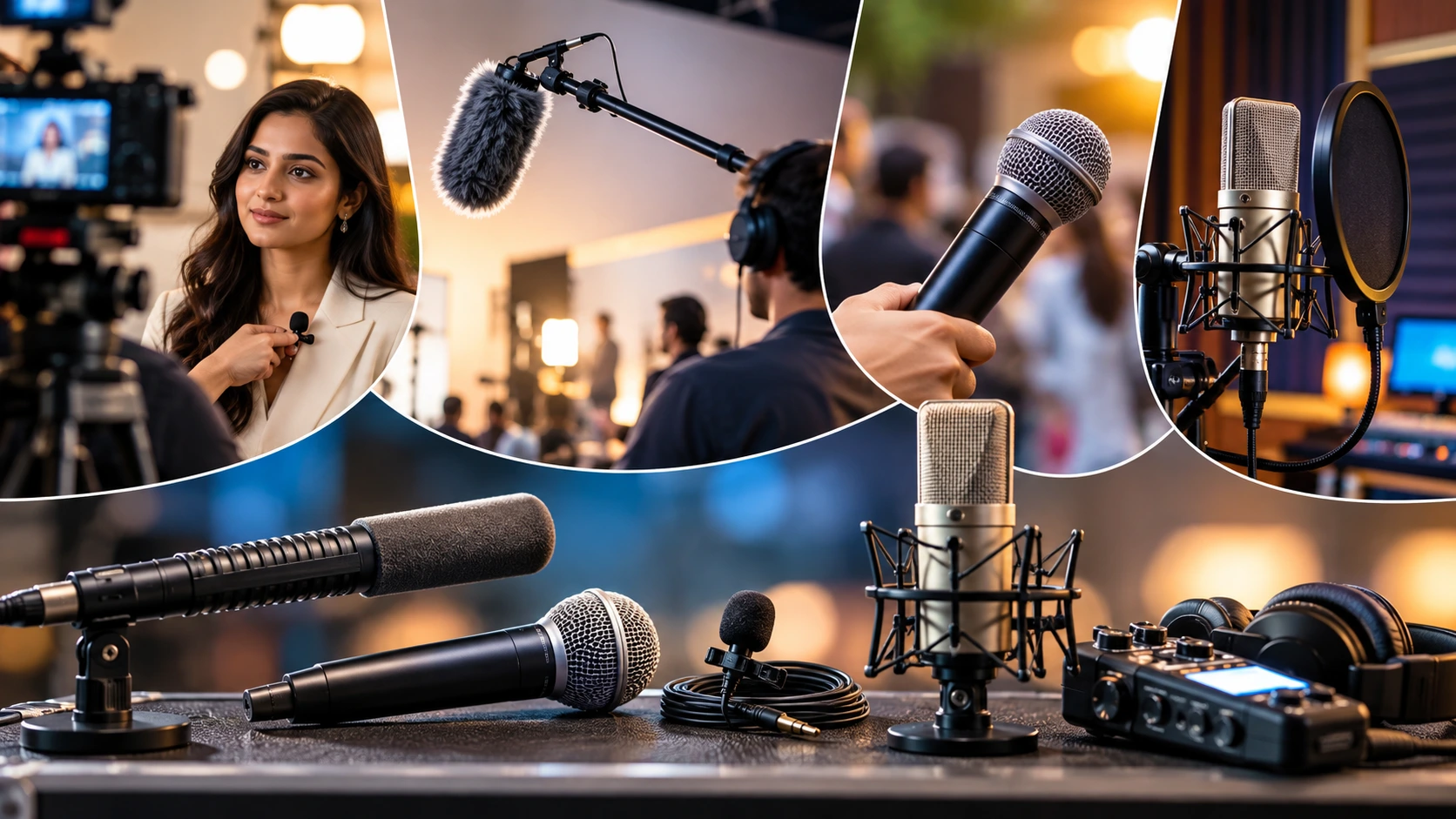
A shotgun microphone is the standard tool mounted on a boom pole just out of frame, capturing dialogue from a tight, directional pattern while rejecting most sound from the sides. It's the workhorse of scripted scenes because it lets a boom operator follow dialogue closely without the mic ever entering the shot, picking up a focused voice while minimizing room noise around it — which is exactly why it stays the default choice for almost any dialogue scene shot on a controlled set.
A lavalier — the small clip-on mic attached to a performer's clothing — solves a different problem: scenes with significant movement, multiple people talking over each other, or wide shots where a boom simply can't get close enough without entering the frame. Because it's worn directly on the subject, it stays consistent in volume even as they move, though it picks up clothing rustle and handles noise far more easily than a boom-mounted shotgun would.
A handheld dynamic microphone — rugged, simple, and resistant to background noise — is the standard choice for run-and-gun documentary interviews and on-camera reporting. It's less sensitive than a condenser mic, which sounds like a downside until you're recording in a noisy market or a crowded event, where that reduced sensitivity is exactly what keeps a subject's voice intelligible over the surrounding chaos — a trade-off documentary crews learn to appreciate quickly.
A condenser microphone is far more sensitive and captures a richer, more detailed sound than a dynamic mic — ideal for voice-over recording, ADR (replacing dialogue in post), or any controlled studio environment where background noise isn't a concern. That same sensitivity is a liability on a noisy set, which is why condensers rarely show up on location and almost always live in a treated recording booth instead.
A new student crew will often default to whichever microphone they grabbed first, regardless of the scene. Using a sensitive condenser mic on a busy outdoor location captures every passing vehicle along with the dialogue; using a directional shotgun mic on a wide scene with three moving actors leaves two of them inaudible the moment they step outside its pickup pattern. Matching microphone type to scene type — not just plugging in whatever's closest — is one of the fastest ways to tell trained sound recordists from untrained ones on a student set, and it's usually the very first habit instructors correct once filming actually begins.
Even a well-chosen microphone produces a recording that needs balancing and mixing afterward — leveling dialogue against ambient sound, smoothing out inconsistencies between a boom and a lavalier used in the same scene, and making sure the final mix doesn't have jarring volume jumps from one cut to the next. Good microphone choice on set makes that mixing work dramatically easier; a bad choice on set creates problems no amount of mixing can fully fix afterward.
Microphone choice is one of those skills that's genuinely hard to learn from reading alone — it has to be tested across different rooms, distances, and amounts of background noise before the trade-offs actually click.
If you're comparing programs for a sound recording course, check whether students actually get hands-on time recording and mixing across multiple real scenarios, rather than just a single classroom demo of each microphone type.
Reading about a boom mic versus a lavalier only goes so far. GKFTII's Video Editing & Sound Recording course puts both in your hands across real scenes until the trade-offs actually click.