Written by the GKFTII Academic Content Team, in collaboration with School of Film & Television faculty
Point a camera at an actor and you've captured a performance. Decide where to put that camera, how much of the scene to include, and whether to look up at the actor or down at them, and you've started actually telling a story. That second layer — the deliberate choice of shot and angle — is what separates footage that merely records an event from footage that makes an audience feel something. It's usually the first practical language taught in any serious cinematography course, because every other technique, from lighting to editing, builds on the shots you chose to capture in the first place.
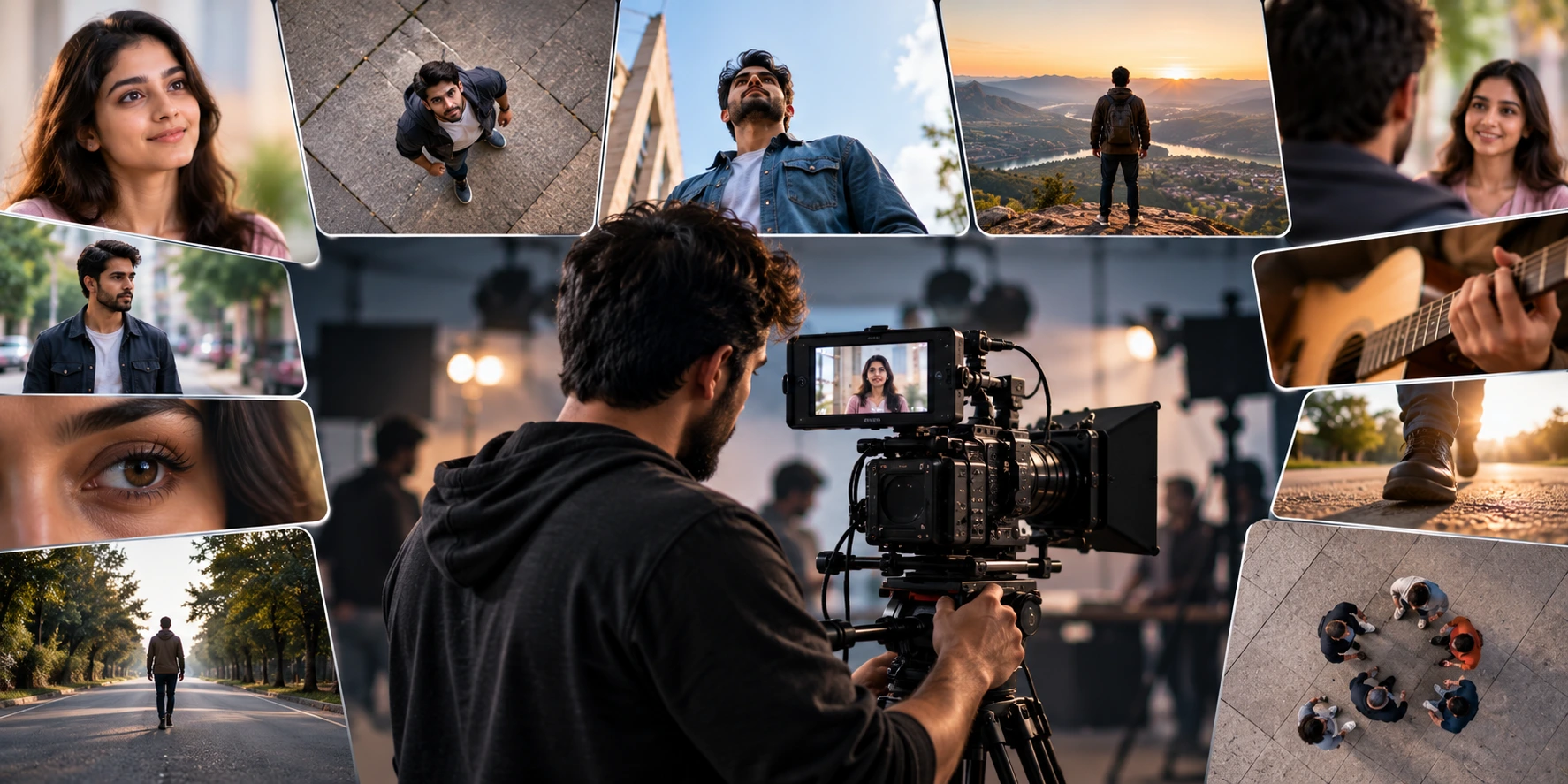
A camera shot is defined by how much of the subject and surroundings fit inside the frame. A wide shot places a character in their environment and tells the audience where they are and how they fit — small in a vast landscape, or dwarfed by a city. A medium shot, roughly waist-up, is the workhorse of dialogue scenes because it keeps both the performance and some body language visible. A close-up isolates a face and forces the audience to read emotion, while an extreme close-up on eyes or hands turns a small detail into the most important thing on screen. Choosing the shot size is choosing what the viewer is allowed to notice.
If shots control what we see, angles control how we judge it. A low-angle shot looks up at a subject and makes them feel powerful, dominant, or threatening. A high-angle shot looks down and does the opposite — it makes a character seem small, vulnerable, or overwhelmed. An eye-level angle feels neutral and honest, which is exactly why it's used for straightforward conversation. Push further and a Dutch tilt — the frame deliberately tilted off-horizontal — signals unease, disorientation, or that something is wrong, without a single line of dialogue explaining it.
In real filmmaking, these two choices are never made in isolation — they combine to build meaning. A close-up filmed from a low angle reads very differently from the same close-up filmed from above: one makes a character imposing, the other makes them pitiable. Directors and cinematographers plan these combinations shot by shot, often on a storyboard or shot list, so that the visual language stays consistent with what the story needs the audience to feel in that moment. Understanding why a scene cuts from a wide establishing shot to a tight close-up — and what that shift does emotionally — is what separates someone operating a camera from someone composing a scene.
Next time you watch a tense confrontation, notice whether the camera looks up at the person in control and down at the person losing the argument — that's angle doing invisible work. When a film suddenly cuts to an extreme close-up of a trembling hand or a single tear, that's shot size directing your attention deliberately. Once you start noticing these choices, you'll see them everywhere — done with intention in great cinema, and done carelessly in flat, forgettable footage where every shot sits at the same safe distance and angle.
A student who memorises shot names without understanding angle will frame technically correct but emotionally empty scenes — everything visible, nothing felt. A student who understands emotional intent but never learns the vocabulary of shot sizes will struggle to communicate that vision to a crew or plan a coherent sequence. Real cinematography training builds both together — the technical grammar of framing and the emotional logic of angle — the same way a writer needs both vocabulary and an ear for what a sentence should make a reader feel.
This is exactly the kind of craft that's hard to learn from tutorials alone, since most online guides list shot types as a glossary without ever explaining why a director would choose one over another in a given emotional beat.
If you're comparing options for a cinematography course, check whether the curriculum teaches shot composition alongside camera movement, lens choice, and lighting — not as isolated definitions, but as tools used together to build a scene. That integration is what determines whether a graduate can walk onto a real set and design coverage for a sequence, rather than just name the shots after the fact.
Shot composition, camera angles, movement, and the on-set decision-making covered above are exactly what's taught hands-on in GKFTII's Diploma in Digital Cinematography — with real cameras and real scenes, not just theory on a slide.