
Written by the GKFTII Academic Content Team, in collaboration with School of Film & Television faculty
Walk onto any real film set and you'll find two roles that sound interchangeable but answer to very different questions. One asks "what should this entire film look like?" The other asks "how do we actually build that, on this budget, by Thursday?" Untangling that difference is one of the first things a properly structured art direction course has to teach, because the two jobs work in completely different directions and are evaluated by completely different measures of success on a real production.
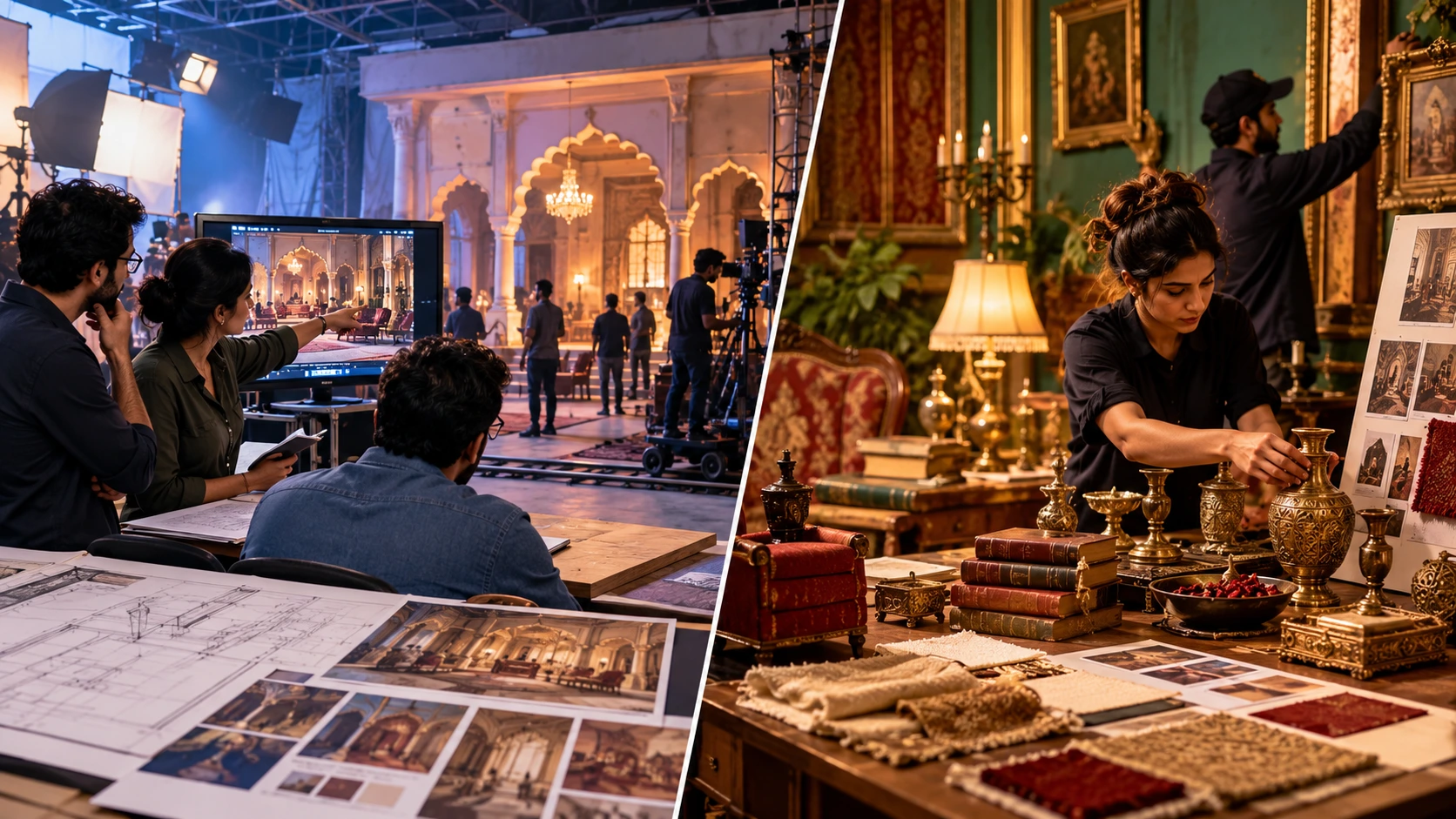
The production designer is responsible for the overall visual world of a film — the architecture of every space, the color palette across locations, the era and texture the audience should feel before a single line is spoken. This role works closest to the director, translating a script's tone into physical, visual decisions: should this character's apartment feel cramped and cluttered, or sparse and cold? That choice belongs to production design, made long before a single set is built, often during early script discussions where the visual world is still just a conversation, not a physical space yet.
Art direction takes that overall vision and turns it into an executable plan — managing the art department, sourcing props and materials, supervising construction crews, and making sure every detail on screen actually matches the production designer's intent within the time and budget available. Where production design asks "what should this feel like," art direction asks "how do we build it, source it, and have it ready before the camera rolls." It's a coordination and execution role as much as a creative one, and on a busy production it often involves managing several smaller teams — props, set construction, set dressing — all working toward the same single deadline.
On smaller productions, especially the kind film students work on early, one person often does both jobs at once, which is exactly why the distinction gets blurry. A student handling both roles on a short film project might choose the "feel" of a location one afternoon and be hauling furniture into it the next — useful experience, but it can hide the fact that on a larger production, these are genuinely two different department heads with two different skill sets and two different sets of responsibilities, reporting through entirely separate chains on a full-scale shoot.
Picture a period drama set in a small apartment. Production design decides the apartment should feel worn down and overcrowded with mismatched furniture, reflecting a family that's outgrown the space. Art direction then has to find or build that exact furniture, age it convincingly, and arrange it within the actual physical dimensions of the set — all while staying inside the art department's budget. If either side fails — a vision with no execution plan, or execution with no clear vision to follow — the look of the film falls apart, even if every individual prop is well made.
A production designer who has never managed a build understands what's beautiful but not always what's buildable. An art director who has never thought through a film's overall tone executes efficiently but can drift from the bigger picture. The strongest training in this area covers both roles together — department structure, the director's overall vision, and how production stages actually unfold — so a student understands the full chain even while developing a preference for one side of it.
Recognizing which side of this divide actually excites you — the big-picture visual thinking or the hands-on execution — is something that's much easier to discover through real set experience than by reading job descriptions.
If you're researching an art direction course, check whether the syllabus actually covers department structure and roles explicitly, rather than treating production design as a footnote inside a general filmmaking curriculum.
Figuring out which side of this divide — vision or execution — actually suits you is exactly what GKFTII's Direction, Production & Screenplay Writing course is structured to help a student discover.